
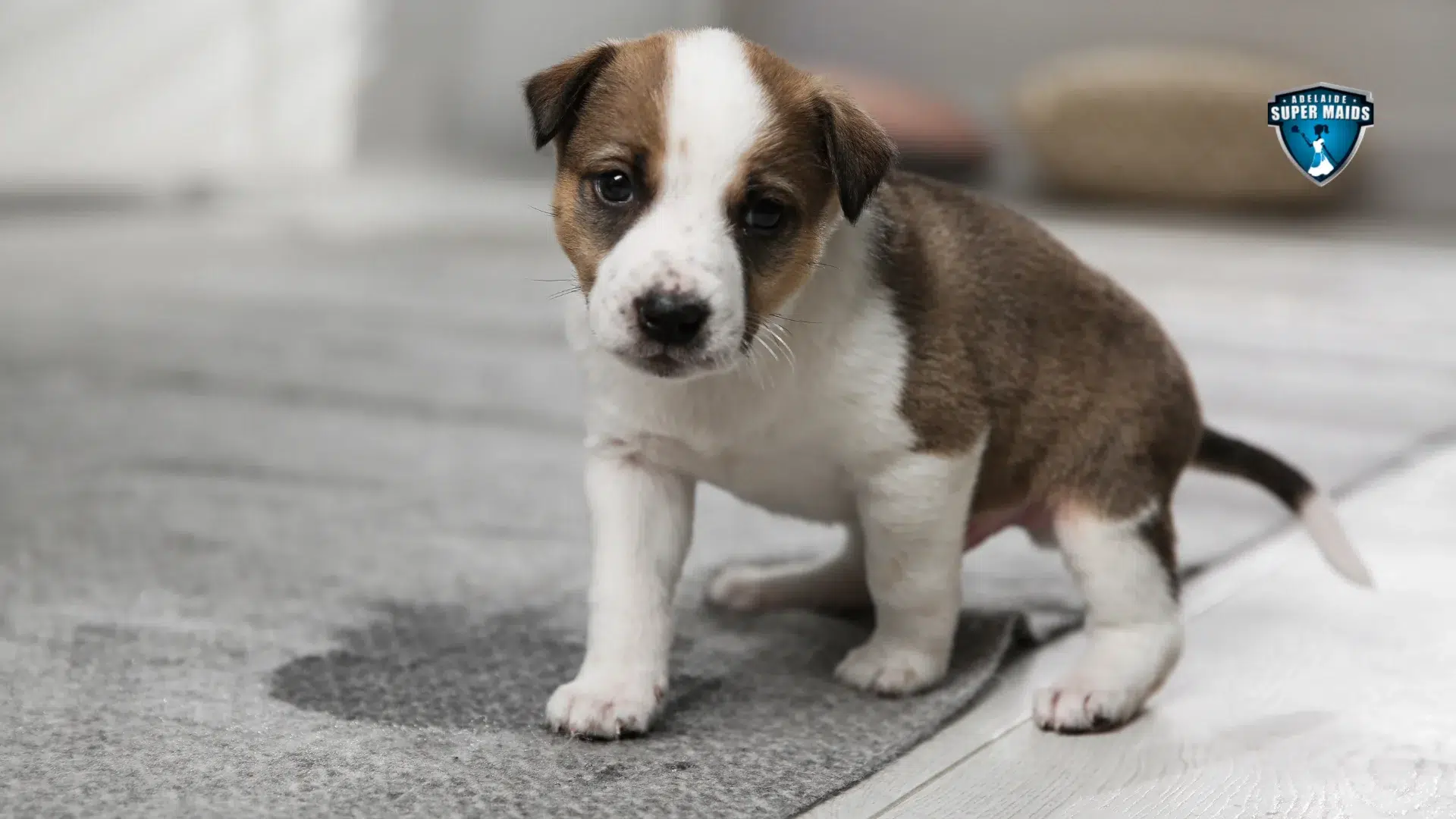
Dog urine on carpet needs prompt blotting, followed by a check of the carpet’s care instructions before any liquid cleaner is added. A small wet patch does not reveal how far the accident has travelled, and the same product or method will not suit every fibre, dye or backing.
This guide covers first aid for a fresh accident, decisions about older marks and the signs that further home treatment could make the problem harder to assess. It focuses on controlled spot care rather than whole-room cleaning, pet training or a promise of permanent odour removal.
Sources checked: 3 November 2026. The guidance below draws on carpet-manufacturer instructions and industry care resources linked beside the relevant points. Your own carpet’s instructions and the chosen product label determine whether a treatment is suitable.
How to Handle Dog Urine on Carpet
For fresh dog urine on carpet, press clean white towels onto the wet area, lift them away and replace them as they become damp. Avoid scrubbing. Keep the area clear while you identify the carpet and check which spot treatments it permits.
- Blot first: Remove available liquid before considering a cleaner.
- Check compatibility: Confirm the fibre, any care restrictions and whether the product is intended for that surface.
- Pre-test: Use a discreet test area and assess it as directed before treating the visible mark.
- Control moisture: Follow the permitted application, contact-time and removal instructions; do not improvise a soaking treatment.
- Reassess: Stop if the pile or colour changes, the patch stays wet or the odour returns after drying.
The International Wool Textile Organisation’s wool carpet care guide distinguishes fresh urine from an old urine stain: its old-stain entry directs the reader to professional assistance. Age and material therefore matter before choosing the next step.
Check the Material and Manufacturer Guidance First
Find the carpet’s care booklet, purchase record or manufacturer details. If the material is uncertain, continue dry blotting a fresh spill while obtaining guidance. Appearance alone is not enough to establish whether wet treatment is permitted.
| Carpet or rug | Decision before adding cleaner |
|---|---|
| Wool or wool blend | Check the carpet instructions and select a product explicitly compatible with the fibre. A pet-cleaner label alone is insufficient. |
| Synthetic carpet | Check the particular product and construction; synthetic fibre does not make every chemical or machine suitable. |
| Sisal, seagrass, coir or viscose | Seek material-specific advice before water-based treatment. These fibres can be moisture-sensitive. |
| Unknown fibre or delicate rug | Keep the response to gentle dry blotting and obtain specialist guidance. |
WoolSafe’s fine-fibre guidance warns that direct application of water-based spot removers can cause problems on moisture-sensitive plant-based and regenerated fibres. It also advises treating a blend according to its most sensitive component.
Do not treat “enzymatic” as a compatibility guarantee
Check both documents: the carpet care instructions and the exact cleaner label. “For pet accidents” describes a purpose; it does not establish suitability for wool, delicate dyes or every backing. WoolSafe’s product-testing information shows why fibre safety, colour stability and specified dilution matter.
If the cleaner’s application method conflicts with the carpet’s restrictions, choose another compatible method or seek advice. A successful hidden test does not override a stated prohibition.
Tools and Products to Prepare
A small first-aid kit helps you respond without reaching for an unrelated household spray. Keep the instructions with the product so dilution, contact time and aftercare can be checked rather than guessed.
- Several clean, absorbent white cloths or plain white paper towels.
- Gloves suitable for the product and task.
- A container or bag for used disposable materials.
- The carpet’s care instructions and a compatible, labelled spot treatment if one is permitted.
- Clean water only if the permitted process calls for it.
- A way to keep pets and children away during treatment and drying.
A product specifically intended for pet urine may be an option on a compatible carpet. Product instructions differ, so there is no universal dose, waiting period or rinse sequence. For example, BISSELL’s pet-urine guidance ties machine use to suitable surfaces, a designated formula and the equipment’s instructions.
A machine is not required for immediate blotting. If extraction is being considered, check the carpet, product and machine requirements together. An ordinary dry vacuum should not be used to collect wet urine.
Step-by-Step Cleaning Method
1. Identify whether the accident is fresh or already dry
For a fresh wet patch, begin absorbing liquid immediately. For an older mark, pause before adding water or another product. Record what is visible, whether the odour is localised and any treatments already attempted. An old mark on wool needs a different decision from a new spill on a carpet with clear spot-care instructions.
2. Blot with clean white absorbent material
Press a dry cloth onto the damp patch, lift it and move to a clean section. Work around the outside towards the centre without dragging the cloth across the pile. Replace damp material rather than continuing with a saturated towel.
This is consistent with Godfrey Hirst’s stain-removal guidance, which recommends prompt absorption, white cloths and blotting instead of rubbing. Blotting is the initial action; it does not confirm that deeper residue has been removed.
3. Check and test the permitted spot treatment
Read the restrictions before opening the product. Test in a discreet location according to the care instructions, allowing the assessment period specified. Compare colour and texture with an untreated area. Stop if dye transfers unexpectedly, the colour changes or the pile looks different.
Do not mix products to make a stronger solution. If earlier cleaners were used, note their names and seek advice where compatibility is unclear.
4. Apply only by the compatible method
Where the carpet instructions require application through a cloth, use that method. Follow the permitted amount and contact time, and avoid spreading the treatment across unaffected carpet. A label directing deep soaking is not permission to disregard a carpet’s moisture restrictions.
Keep track of what was applied. This provides a useful treatment history if the response is poor, rather than leaving the next person to guess which chemicals or quantities remain.
5. Remove excess moisture and residue as directed
At the appropriate point in the product’s process, blot or use compatible extraction equipment as instructed. Some treatments require rinsing; others specify a different removal or drying procedure. Do not automatically rinse away a treatment before its stated contact time.
The Carpet and Rug Institute’s urine spot-care guidance highlights pre-testing, controlled application and residue removal. Follow the applicable instructions rather than repeatedly pouring water through the carpet to chase a mark.
6. Allow drying, then assess the result
Maintain suitable airflow and observe the product’s access restrictions. Keep pets, children and traffic away until both its re-entry conditions and the carpet’s drying requirements are met. Do not use direct heat to speed the process.
Assess appearance, texture and odour after drying. If the patch remains damp, changes shape or smells again, stop adding treatments. A reduced smell while cleaner is present does not establish that the affected layers are clear.
Products and Methods to Avoid
When treating dog urine on carpet, adding more chemistry is not a substitute for checking the material and the source of the problem. The following shortcuts can obscure the result or create additional risks.
- Scrubbing or stiff brushing: Use controlled blotting rather than rough agitation of the affected pile.
- Repeated soaking: Do not keep increasing the water or product quantity when the previous treatment has not worked.
- Unapproved peroxide or bleach: Do not apply a bleaching treatment based on a general internet recipe.
- Stacked household recipes: Avoid layering vinegar, bicarbonate of soda, detergents and a pet cleaner without a compatible manufacturer-approved process.
- Fragrance as a success test: A pleasant smell does not demonstrate removal of the urine source.
- Direct heat or a household steam mop: Do not apply these to an unresolved urine patch.
The CDC warns against mixing bleach or disinfectants with other cleaners because dangerous vapours can be released. That chemical-safety guidance does not make bleach an appropriate carpet treatment.
Understand what “steam cleaning” means
The term is often used commercially for hot water extraction: a process that introduces cleaning solution and water, then recovers moisture and loosened soil by suction. This differs from applying vapour with a steam mop. Temperature, method and suitability need assessment; neither term promises urine removal.
The Carpet and Rug Institute’s maintenance advice cautions against steam cleaning urine spots because heat can set the stain and smell. This is a reason to avoid a blanket DIY heat recommendation, not to assume every professional extraction process is identical.
When to Stop and Request Professional Assessment
Stop home treatment when the safe method is uncertain or the response suggests more than a small surface accident. Relevant signs include:
- Old or extensive staining, especially on wool or an unidentified fibre.
- Colour loss, distorted pile, loose seams or a changed texture.
- Odour returning after the treated area dries.
- Repeated accidents in the same location.
- Persistent dampness or concern that liquid reached underlying layers.
- Several previous products or an unknown chemical treatment history.
The Carpet and Rug Institute’s technical bulletin on pet urine explains that urine can alter dyes and damage carpet construction. Some marks represent permanent change. A surface that looks cleaner may therefore still have a separate odour or material problem.
For a carpet cleaning assessment, provide the fibre if known, approximate affected area, age of the accident, products used and whether the smell returned after drying. Ask whether the proposed scope addresses urine contamination or only general carpet cleaning. No complete stain or odour result should be assumed before assessment.
If the accident also affected a sofa, use the material-specific upholstery cleaning guidance; do not transfer a carpet method automatically. For a rental handover, keep the incident and treatment history separate from the broader end-of-lease cleaning checklist.
Frequently Asked Questions
What should I do first about dog urine on carpet?
Absorb fresh liquid with clean white towels, lifting and replacing them as needed. Avoid rubbing. Check the carpet’s instructions before adding a spot treatment, and keep access to the area controlled.
Can I use an enzyme cleaner on wool carpet?
Only consider a product whose directions and compatibility match your carpet’s care requirements. The word “enzymatic” alone does not establish that. Check the exact formulation, pre-test as directed and seek guidance if the instructions conflict.
Should I pour water onto the urine to dilute it?
Do not use uncontrolled flooding as first aid. Begin with dry absorption. Whether water is suitable, how much to use and how it is removed depend on the fibre, construction and approved cleaning process.
Can I treat an old dog urine stain the same way as a fresh spill?
No automatic match should be assumed. Age, earlier treatments and material changes affect the decision. The wool-care guide cited above directs old urine staining to professional assistance rather than treating it as an ordinary new spill.
Why does the smell return after the carpet dries?
Residue may remain beyond the visible surface, or a product may have temporarily masked the smell. The appearance and smell alone cannot establish the condition of the backing or underlay. Further assessment is more useful than repeated surface spraying.
Does a yellow mark mean urine is still present?
It may be staining or a change to the carpet’s dyes; appearance alone cannot distinguish them reliably. A persistent mark is not a reason to keep increasing chemical strength or scrubbing pressure.
Will hot water extraction remove every urine stain and odour?
No. The appropriate process depends on the material, affected layers and previous treatment. Extraction is a cleaning method, not a guarantee that contamination below the pile or permanent dye damage can be resolved.
Can I use the same method on a rug or sofa?
Check its own care requirements first. A rug can contain moisture-sensitive fibres or dyes, while upholstery has its own construction and cleaning restrictions. A carpet product’s suitability cannot be transferred automatically.
Prompt blotting is the first response to fresh dog urine on carpet. The next decision should follow the material and product instructions, with a clear stopping point when the result or safe method is uncertain.
Sources and Scope of This Guide
Sources were checked on 3 November 2026. This article synthesises published guidance; it does not report a test performed on the reader’s carpet or claim a guaranteed treatment outcome. General references support the decisions discussed, while the carpet manufacturer’s instructions and a compatible product label govern the actual treatment.
- International Wool Textile Organisation — Wool Carpet Care Guide, 2024: fresh and old urine entries and their treatment decisions.
- Godfrey Hirst — Carpet Stain Removal: blotting and care precautions.
- WoolSafe — Cleaning and Maintenance of Fine Fibres; Product Testing: material sensitivity and product suitability.
- Carpet and Rug Institute — Urine, Dry; Cleaning and Maintenance; Technical Bulletin: Pet Urine and Carpet.
- BISSELL — How to Remove Dog and Cat Urine Smell from Carpet: equipment and product instructions.
- CDC — Cleaning and Disinfecting with Bleach: the warning against mixed cleaning chemicals.